
The Role of NYS Department of Health: A Family Guide
TL;DR:
The New York State Department of Health oversees healthcare facilities, Medicaid, vital records, and public health programs. It regulates hospitals, nursing homes, home care agencies, and manages services for 8.7 million Medicaid enrollees, with a focus on community health initiatives and emergency response. Families should verify agency licensing and use official channels for records and complaints to ensure quality and accountability.
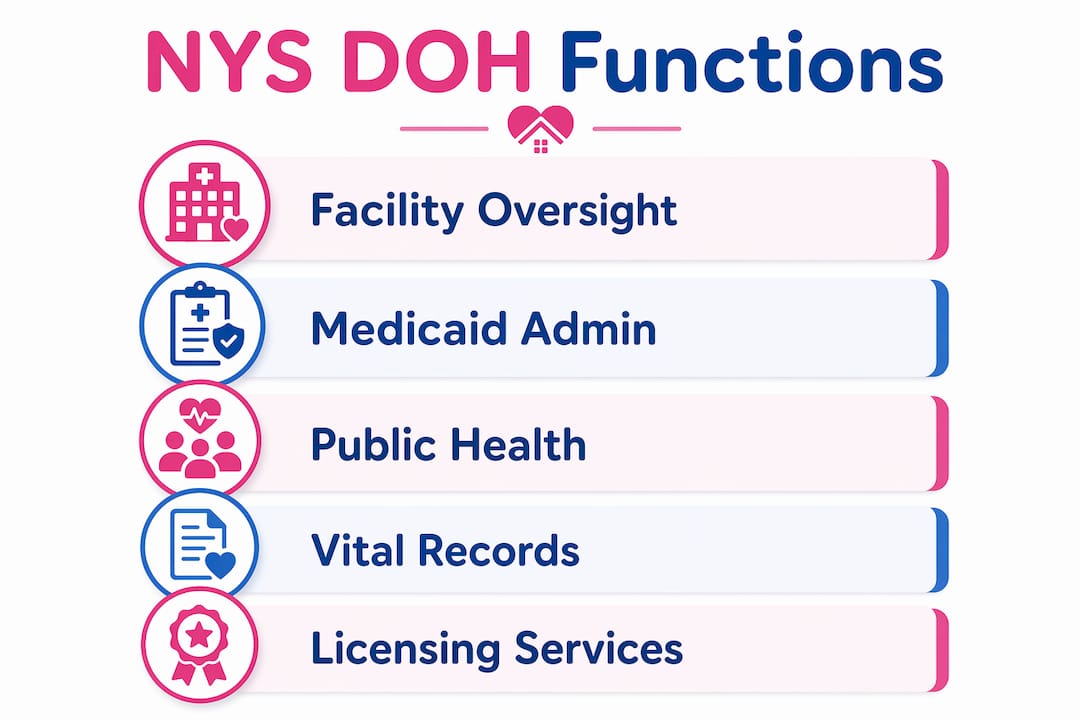
The New York State Department of Health is the chief state agency responsible for regulating health facilities, overseeing Medicaid, managing vital records, and coordinating public health programs throughout New York State. Understanding the role of NYS Department of Health matters directly to families making decisions about hospitals, home care, insurance coverage, and public health resources. The department operates under Article 28 of the Public Health Law, giving it authority over thousands of licensed facilities and 8.7 million Medicaid enrollees. That scale makes it one of the most consequential state health agencies in the country.
What healthcare facilities does the NYSDOH regulate?
The NYSDOH licenses and inspects every major category of healthcare facility in New York State. That list includes hospitals, nursing homes, diagnostic and treatment centers, and home care agencies. Each facility must meet certification standards tied directly to federal Medicare and Medicaid Conditions of Participation. Failing those standards can cost a facility its federal reimbursement, which is a serious financial consequence that drives compliance.
Regulation under Article 28 of the Public Health Law sets the legal foundation for this oversight. The department conducts routine surveys and complaint-driven inspections to verify that facilities meet required standards of care. When deficiencies are found, enforcement classifies them by severity, with the most serious findings triggering accelerated action consistent with federal Centers for Medicare and Medicaid Services protocols. That tiered system means a nursing home with a minor paperwork issue faces a very different response than one with a patient safety failure.
For families, this regulatory structure provides a meaningful layer of protection. You can file a complaint directly with the NYSDOH if you believe a hospital, nursing home, or home care agency has failed to meet required standards. The department investigates those complaints and can impose corrective action plans, fines, or license revocation.
Here is what the NYSDOH regulates under its facility oversight authority:
Hospitals (general, specialty, and psychiatric)
Nursing homes and adult care facilities
Diagnostic and treatment centers (outpatient clinics, dialysis centers)
Licensed home care services agencies and certified home health agencies
Hospice programs and other community-based care providers
Pro Tip: If you are choosing a home care agency for a family member, verify that the agency holds a current NYSDOH license. Licensed agencies must meet state inspection standards, which protects your family from unregulated providers.
How does NYSDOH administer Medicaid and health coverage programs?
The NYSDOH serves as the primary administrator of New York’s Medicaid program, which covers 8.7 million enrollees statewide. That number represents roughly 44% of New York State’s total population. Medicaid funds a wide range of services, from hospital stays and physician visits to home care and long-term care for seniors and people with disabilities.
Effective july 1, 2026, New York restructured the Essential Plan by lowering income eligibility for premium-free coverage from 250% to 200% of the federal poverty line. That change affects approximately 1.3 million New Yorkers. Families near that income threshold should verify their current eligibility directly with the NYSDOH or their local Department of Social Services.
The NYSDOH coordinates closely with the federal Centers for Medicare and Medicaid Services on program rules, funding, and compliance. State policy decisions must align with federal requirements to maintain federal matching funds. That partnership shapes everything from which services Medicaid covers to how providers get paid.
Program | Who it covers | Key 2026 change |
Medicaid | Low-income individuals and families | Ongoing enrollment; 8.7 million enrollees statewide |
Essential Plan | Adults up to 200% federal poverty line | Eligibility threshold lowered from 250% effective july 2026 |
Child Health Plus | Uninsured children under 19 | Administered through NYSDOH-approved health plans |
Pro Tip: If your household income recently changed, check your Medicaid or Essential Plan eligibility at ny.gov/health before assuming you no longer qualify. The 2026 restructuring preserved coverage for most current enrollees.
What public health initiatives does the NYSDOH lead?
Disease surveillance is one of the NYSDOH’s most critical functions. The department monitors over 80 reportable communicable diseases, requiring mandatory reporting from physicians and laboratories to local health departments and the state. That system is how New York detects and responds to outbreaks before they spread widely.
Beyond disease tracking, the NYSDOH runs programs that reach directly into neighborhoods. The Healthy Neighborhoods Program is a state-funded initiative providing free in-home health hazard interventions, including smoke detector installation and lead safety education, across 17 counties and New York City. The program addresses health risks before they become medical emergencies, which saves both lives and healthcare costs.
Heat-related illness is a growing public health concern in New York. The NYSDOH provides residents with the Heat Risk and Illness Dashboard and the Heat Vulnerability Index, two tools that track local and statewide heat risk in real time. Community planners, local health departments, and families can use these tools to prepare for extreme heat events. The Essential Plan Cooling Program expanded its coverage to 16 health conditions for free air conditioner eligibility as of june 2026, giving more residents access to cooling equipment during dangerous heat waves.
The NYSDOH coordinates with all 58 county health departments across the state. That local coordination is how state-level policy translates into community-level action. When an emergency arises, residents can reach the NYSDOH General Information Line at 1-833-364-4695 or the urgent public health emergency line at 1-866-881-2809.
Key public health functions the NYSDOH leads:
Communicable disease surveillance and outbreak response
Environmental health programs (lead, asbestos, drinking water safety)
Maternal and child health programs
Chronic disease prevention and tobacco control
Emergency preparedness and coordination with local health departments
Heat illness prevention and climate health initiatives
What vital records and licensing services does the NYSDOH provide?
The NYSDOH maintains birth, death, marriage, and divorce records for New York State, with one significant exception. NYC residents must request records from the New York City Department of Health and Mental Hygiene, not the state department. That distinction trips up many families who assume one agency handles all of New York. Sending a request to the wrong office adds weeks to the process.
For residents outside New York City, the NYSDOH processes vital records requests for events that occurred anywhere in New York State except the five boroughs. Certified copies of birth certificates, death certificates, and marriage records are available through the department’s Vital Records Section. Processing times and fees vary by request type.
Professional licensing is a separate matter that families often confuse with NYSDOH functions. Physician and nursing licenses are administered by the NYS Education Department Office of the Professions, not the NYSDOH. If you want to verify a doctor’s license or file a complaint about a physician’s conduct, the correct agency is the NYS Education Department, not the health department.
Here is a quick reference for common record and licensing needs:
Birth, death, marriage records (outside NYC): Contact NYSDOH Vital Records Section
Birth, death, marriage records (NYC residents): Contact NYC Department of Health and Mental Hygiene
Physician or nurse license verification: Contact NYS Education Department Office of the Professions
Home care agency license verification: Contact NYSDOH Division of Home and Community Based Care
Hospital or nursing home complaints: File directly with NYSDOH
Pro Tip: Before filing any complaint or records request, confirm which agency holds jurisdiction. Sending a complaint about a doctor to the NYSDOH instead of the NYS Education Department will delay your case. A quick check at health.ny.gov clarifies the correct contact for most situations.
Key Takeaways
The NYS Department of Health regulates facilities, administers Medicaid for 8.7 million enrollees, manages vital records, and leads public health programs that directly affect every New York family.
Point | Details |
Facility regulation under Article 28 | NYSDOH licenses and inspects hospitals, nursing homes, and home care agencies statewide. |
Medicaid administration | The department oversees 8.7 million enrollees and adjusted Essential Plan eligibility in july 2026. |
Disease surveillance | NYSDOH monitors over 80 reportable diseases through mandatory physician and lab reporting. |
Vital records jurisdiction | NYC residents must use the NYC Department of Health, not NYSDOH, for vital records. |
Professional licensing | Physician and nurse licenses are held by the NYS Education Department, not NYSDOH. |
Why NYSDOH’s evolving role matters more than most families realize
State Health Commissioner Dr. James McDonald has been direct about the department’s direction: NYSDOH is building localized public health expertise rather than depending on federal CDC leadership. That shift is not just administrative. It means New York is investing in its own capacity to respond to health threats, set policy, and protect residents independent of federal priorities.
I find that shift genuinely significant. For years, state health departments were seen as implementers of federal guidance. What I see now is a department that is asserting its own authority and building the infrastructure to back it up. The health equity focus is real, not just language in a press release. The department is actively working to close gaps in access based on race, income, and ZIP code.
The workforce challenge is the piece that does not get enough attention. NYSDOH is expanding independent practice for nurse practitioners and physician assistants in underserved areas. That is a practical response to a real shortage. Families in rural upstate communities and underserved urban neighborhoods will feel the benefit of that policy before they ever read about it.
My honest advice to any New York family: treat the NYSDOH website as a primary resource, not a last resort. The tools, program information, and complaint procedures are there. Using them puts you in a stronger position when you need care, records, or accountability from a health facility.
— Brigid
How Friendlyhomecareny supports families within NYSDOH standards
Friendlyhomecareny is fully licensed by the NYS Department of Health and accredited by The Joint Commission, which means the agency meets the same regulatory standards the NYSDOH enforces across all licensed home care providers in New York. For families navigating safe home care in NYC, that licensing provides a concrete assurance of quality and accountability. Friendlyhomecareny offers personal care assistance, companionship, medication reminders, mobility support, and post-hospital recovery care across Brooklyn, Queens, Manhattan, the Bronx, Staten Island, and Westchester County. Multilingual caregivers serve NYC’s diverse communities with culturally sensitive, personalized care plans. To learn more about our home health services, contact Friendlyhomecareny to schedule a consultation.
FAQ
What does the NYS Department of Health regulate?
The NYSDOH regulates hospitals, nursing homes, home care agencies, and diagnostic centers under Article 28 of the Public Health Law. It also administers Medicaid, manages vital records for New York State outside NYC, and oversees public health programs statewide.
How many people does NYS Medicaid cover?
The NYSDOH administers Medicaid for approximately 8.7 million enrollees across New York State. That figure makes New York one of the largest state Medicaid programs in the country.
Where do NYC residents get vital records?
NYC residents must request birth, death, and marriage records from the New York City Department of Health and Mental Hygiene. The NYSDOH handles vital records only for events that occurred outside the five boroughs.
Who licenses doctors and nurses in New York?
Physician and nursing licenses are issued and maintained by the NYS Education Department Office of the Professions, not the NYSDOH. Complaints about a doctor’s conduct should go to the NYS Education Department.
How can I contact the NYSDOH for a health emergency?
Call the NYSDOH urgent public health emergency line at 1-866-881-2809 for immediate concerns. For general inquiries, the main information line is 1-833-364-4695.
Recommended