
What is accredited home care? Your guide to verified quality
TL;DR:
Accredited home care agencies are evaluated on their organizational policies, systems, and safety procedures, not individual caregiver certifications.
While accreditation indicates a high standard of organizational quality, families should still verify caregiver qualifications and cultural fit before choosing care providers.
When a family member needs in-home support, most families assume that choosing an “accredited” agency means every caregiver walking through the door holds an individual certification. That assumption feels logical, but it is not always accurate. Accreditation works at a different level entirely, and understanding that difference can shape the quality of care your loved one receives. In this guide, we break down exactly what accredited home care means, how agencies in New York City and Westchester earn that status, and how you can use this knowledge to make a truly informed decision.
Table of Contents
Key Takeaways
Point | Details |
Accreditation explained | Accreditation shows a home care agency meets high standards for practices, policies, and training. |
Family benefits | Accreditation offers extra reassurance but should be combined with your own research. |
Ongoing evaluation | Accredited agencies are regularly reviewed to ensure continued quality and safety. |
More than a certificate | Accreditation is a great starting point, but finding the right fit requires asking questions and staying involved. |
What does accredited home care really mean?
Now that we have set expectations, let us define exactly what accreditation means in the context of home care.
Accredited home care refers to an agency that has been formally evaluated and recognized by an independent, outside organization. That organization reviews the agency’s systems, policies, training programs, safety procedures, and supervision practices. If the agency meets the required standards, it earns accreditation. This is not a one-time honor. It is an ongoing commitment to quality that the agency must continuously uphold.
Here is where many families get confused. They imagine accreditation as a stamp on each caregiver’s resume. In reality, as noted by the Accreditation Commission for Health Care, accreditation evaluates the agency’s policies, training, and care processes rather than individual caregiver credentials. The agency’s structure, its hiring practices, its supervision model, and its documented quality controls are all what get reviewed.
Think of it this way. A restaurant can earn a health inspection rating based on its kitchen procedures, food handling policies, and cleanliness systems. That rating does not mean every cook has a culinary degree. It means the systems in place meet a required standard.
“Agency accreditation focuses on the system, not every individual.” This distinction matters enormously when you are choosing care for a senior parent or a family member recovering from surgery.
Common misconceptions families hold:
All caregivers at an accredited agency are personally certified by the accrediting body
Accreditation replaces the need to ask about individual caregiver qualifications
All accredited agencies offer the same level of personalized care
Accreditation is permanent once awarded
None of those assumptions hold up under scrutiny. Accreditation establishes that the agency meets a rigorous standard at the organizational level. It does not replace individual competency checks, background screenings, or the personal fit between caregiver and client.
Families in New York City and Westchester can use our NYC home care quality guide to learn more about evaluating agencies in their neighborhoods. Understanding the characteristics of quality home care will also help you build the right questions before you commit.
How agencies in NYC and Westchester earn accreditation
With the basics in place, let us look at how local agencies actually earn and maintain accreditation.
Home care agencies serving New York City and Westchester County may seek accreditation from several recognized bodies. The most commonly respected names include The Joint Commission, the Accreditation Commission for Health Care (ACHC), and the Community Health Accreditation Partner (CHAP). In New York, agencies must also be licensed by the New York State Department of Health, which sets its own baseline requirements before any accrediting body is even involved.
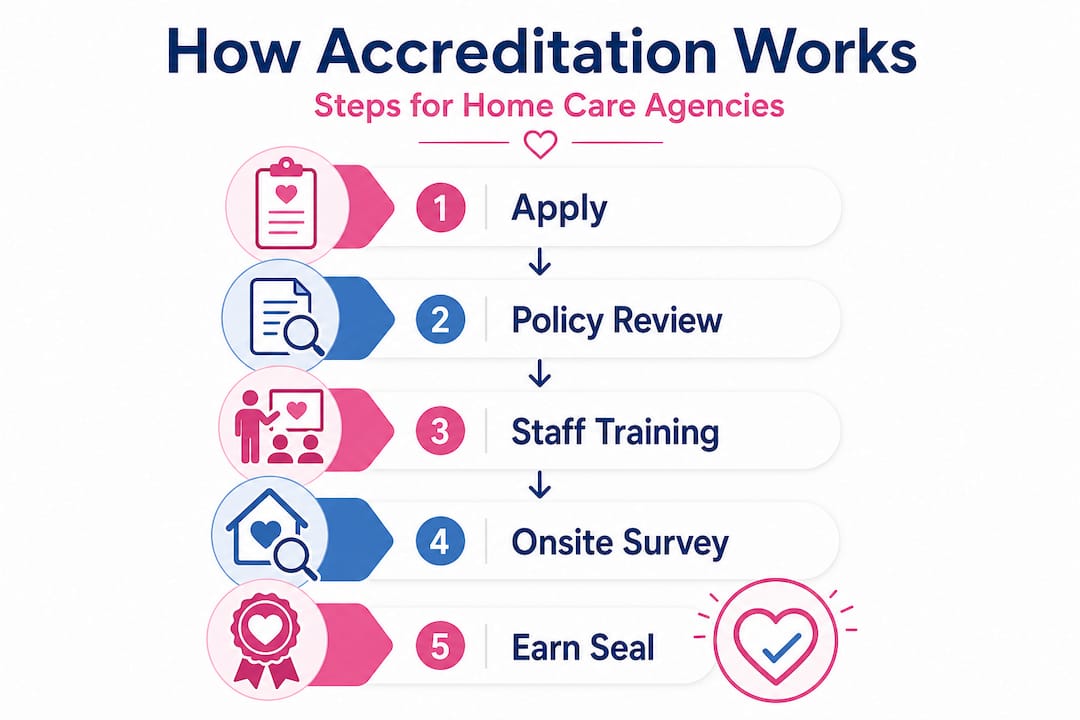
Agencies follow structured processes to meet specific standards before earning accreditation. Here is how the typical process unfolds:
Application and intent. The agency formally applies to the accrediting body and declares its intent to meet the required standards.
Self-assessment. The agency conducts an internal review of all its current policies, staff training programs, care protocols, and documentation practices.
Policy and process review. The accrediting organization reviews all submitted documentation, looking for gaps between current practice and required standards.
Staff training alignment. The agency updates or reinforces training programs to meet accreditation requirements, often covering areas like infection control, emergency response, and patient rights.
On-site evaluation. Surveyors visit the agency and often observe actual care delivery, interview staff and sometimes clients, and review records in detail.
Report and response. The agency receives findings, addresses any deficiencies, and demonstrates corrective action before accreditation is awarded.
This process is not quick or easy. It typically takes six months to over a year for an agency to earn accreditation from scratch.
Major accrediting bodies and what they evaluate:
Accrediting body | Key focus areas | Seal to look for |
The Joint Commission | Safety, care quality, leadership, patient rights | Gold Seal of Approval |
ACHC | Clinical care, staffing, documentation, compliance | ACHC Accreditation Seal |
CHAP | Community care standards, quality outcomes, governance | CHAP Accreditation Seal |
NYS Department of Health | State licensure, minimum care standards | NY State License |
Pro Tip: Most accrediting bodies require agencies to renew accreditation every one to three years. That renewal process involves fresh evaluations, not just a rubber stamp. For families, this means an agency’s accreditation status is a living indicator of its ongoing commitment to quality, not just a past achievement. Always ask when an agency last completed its accreditation review and what was updated.
You can explore the detailed accreditation process or review the home care workflow for families to understand how these standards translate into day-to-day care at home.
Why accreditation matters for families and loved ones
Now that you know how agencies are accredited, let us focus on how this choice makes a real difference for your family.
Choosing an accredited agency is not just about checking a box. Accreditation provides an extra layer of trust and safety for patients and their families. That extra layer shows up in practical, daily ways.
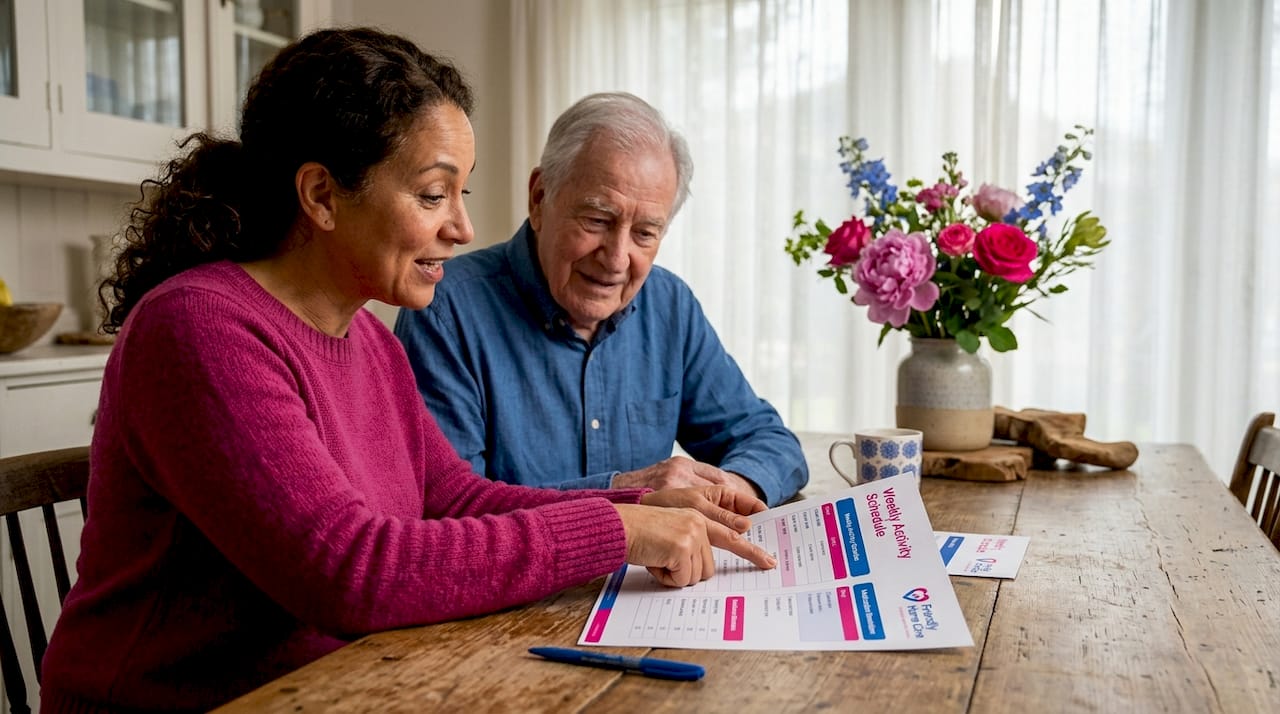
When a caregiver follows a documented care protocol, your loved one receives more consistent support. When a supervisor conducts regular check-ins because the agency’s accreditation requires it, problems get caught earlier. When staff are trained in infection control and fall prevention because those topics are part of the accreditation standard, your senior family member is safer at home.
Here is a side-by-side view of what separates accredited from non-accredited agencies:
Factor | Accredited agency | Non-accredited agency |
External oversight | Yes, by recognized body | No independent review |
Staff training standards | Defined and documented | May vary widely |
Care documentation | Structured and audited | Often informal |
Risk reduction protocols | Required by accreditation | Not guaranteed |
Family recourse options | Clear complaint and review process | May lack formal process |
Quality improvement | Ongoing and required | At agency’s discretion |
Quality issues that accreditation typically helps prevent:
Gaps in caregiver training that lead to unsafe medication reminders
Poor documentation that results in care inconsistencies between shifts
Lack of supervision that allows caregiver behavior to go unchecked
Absence of emergency response plans for clients with complex needs
Inadequate background screening processes for new staff
Pro Tip: Accreditation is a strong signal, but it is not the whole story. Always ask the agency directly about how individual caregivers are screened, what their background check process looks like, and how they match caregivers to specific client needs. An accredited agency that takes these questions seriously is showing you something just as important as the certificate on the wall.
For families thinking about customized care plans, accreditation ensures that the agency has the systems to build and follow through on those plans consistently. Families dealing with memory conditions should also look at resources on dementia care and accreditation to understand how quality systems protect vulnerable seniors at every stage.
Finding quality home care for families takes more than a quick search. Accreditation gives you a reliable starting point.
Choosing the right accredited home care agency
Understanding the importance is key. Here is how to put it into practice when choosing care for your loved one.
Not every accredited agency will be the right fit for your family. Accreditation confirms the agency meets quality standards. It does not guarantee the agency speaks your language, understands your loved one’s cultural background, or specializes in the specific type of care your senior needs. Your job as a family is to go beyond the accreditation seal.
Step-by-step guide for vetting an accredited agency:
Confirm current accreditation status. Ask for the accrediting body’s name and verify it directly on that organization’s website. Do not accept a verbal assurance alone.
Check state licensure. In New York, confirm the agency holds an active license from the New York State Department of Health. Both accreditation and state licensure should be in place.
Ask about individual caregiver screening. How does the agency conduct background checks? What training do caregivers complete before their first assignment? Are there ongoing competency evaluations?
Request references or client testimonials. Families who have used the agency can tell you things no certificate will. Ask specifically about communication, reliability, and how problems were handled.
Evaluate the intake and care planning process. A quality accredited agency will conduct a thorough assessment before placing a caregiver. If they skip that step, it is a red flag.
Assess cultural and language fit. In New York City and Westchester, multilingual care is often essential. Ask whether the agency can match your loved one with a caregiver who speaks their preferred language.
As the ACHC notes, agency accreditation doesn’t replace the need for careful family research and personal fit. The accreditation review does not sit with your parent in the living room. The caregiver does.
Quick checklist before you commit:
Accreditation seal verified directly with the accrediting body
Active New York State Department of Health license confirmed
Individual caregiver background check process explained clearly
Care plan assessment scheduled before services begin
Supervisor contact information provided
Clear communication process established for concerns or changes
For families still in the planning stage, our guide on planning safe home care walks through every step. If you are just getting started, our resource on starting home care services gives you a practical roadmap from day one.
Why accreditation should be your starting point, not the whole journey
Having explored accredited home care from all angles, let us share some hard-won perspective every family should know.
We have spoken with many families across Brooklyn, Queens, the Bronx, Manhattan, Staten Island, and Westchester who chose an agency based primarily on its accreditation status. Some of those families had excellent experiences. Others were surprised to discover that a beautifully accredited agency did not communicate well with their family, could not match their cultural expectations, or simply did not feel right in the home.
Accreditation establishes a floor of quality. It does not build a ceiling of excellence. Real quality in home care is proven daily at the bedside, not in a binder of policy documents.
Consider a family in Queens who chose an agency that held both Joint Commission accreditation and a New York State license. On paper, it looked perfect. But within two weeks, they realized the caregivers assigned to their mother were not comfortable with her preferred language, and the agency was slow to respond to requests for a different match. The accreditation was real. The personal fit was not.
That experience does not make accreditation less important. It makes the full picture more important. As ACHC points out, accreditation reviews the system, not every individual, so family diligence remains essential regardless of what the certificate says.
There is also a trap many families fall into: they treat the accreditation conversation as the end of their research rather than the beginning. They see a seal, they feel reassured, and they stop asking questions. The families who get the best outcomes do the opposite. They use accreditation as a filter to narrow the field and then dig deeper into the individual agency’s people, culture, and communication.
We believe strongly, and our experience working with families across New York confirms it, that the importance of home care for seniors goes far beyond policy documents. It lives in the relationship between caregiver and client. Accreditation helps ensure the structure around that relationship is sound. Your family’s research helps ensure the relationship itself is the right one.
Connect with trusted, accredited home care in NYC and Westchester
Ready to take the next step toward safer, higher-quality home care for your family?
At Friendly Home Care, we are fully licensed by the New York State Department of Health and accredited by The Joint Commission. That means we have already passed the rigorous evaluations this article describes. But we also know that accreditation is just the beginning of what your family deserves. Every caregiver we place is individually screened, trained, and matched to your loved one’s specific needs, personality, and cultural background.
We serve families in Brooklyn, Queens, Manhattan, the Bronx, Staten Island, and Westchester County with multilingual caregivers, personalized care plans, and a dedicated team that answers your questions and responds to your concerns. Whether your family needs short-term post-hospital support or long-term in-home assistance, we are here to help.
Explore our accredited home care services or visit Friendly Home Care to schedule a consultation today. Quality care for your loved one starts with one conversation.

Frequently asked questions
Does accreditation mean all caregivers are certified?
No. Accreditation evaluates the agency’s policies and training systems, not the individual credentials of every caregiver on staff. Always ask the agency directly about individual caregiver qualifications.
Who gives accreditation to home care agencies in NYC?
Common accrediting bodies include The Joint Commission, ACHC, and CHAP, and agencies are evaluated through structured reviews before earning their accreditation seal. New York State licensure through the Department of Health is also required separately.
How often do agencies get re-accredited?
Most agencies must renew accreditation every one to three years, and agencies are periodically re-evaluated with updated reviews and inspections to confirm they are still meeting required standards.
Is an accredited agency always better than a licensed one?
Both credentials matter, but accreditation provides an extra layer of trust and safety beyond what basic state licensing requires. An agency that holds both a state license and accreditation has met two independent sets of quality standards.
Recommended