
What Is Hourly Home Care? a Family Guide

TL;DR:
Hourly home care provides flexible, part-time professional support in a client’s own home, accommodating mostly independent individuals needing assistance during specific times. It offers cost savings, preserves independence, and adapts to changing needs, but may involve less caregiver consistency compared to live-in arrangements. Families should choose licensed, reputable agencies and regularly reassess care plans to ensure the right balance of support and autonomy.
When a parent starts struggling with daily tasks but clearly doesn’t need round-the-clock supervision, many families hit a wall. What is hourly home care, exactly, and is it the right answer? Simply put, hourly home care is professional, part-time assistance provided in a person’s own home on a scheduled basis. It’s not a watered-down version of full care. It’s a deliberate, flexible model designed for people who are mostly independent but need real support during specific parts of the day. This guide covers how it works, what it costs, and how to decide if it fits your family’s situation.
Table of Contents
Key takeaways
Point | Details |
Flexible scheduling | Hourly care can be arranged for as few as a couple of hours per week or expanded significantly as needs grow. |
Part-time cost savings | Families pay only for the hours used, making it far more affordable than live-in or 24/7 care for those with limited daily needs. |
Professional, screened caregivers | Agency caregivers are trained, background-checked, and often multilingual to serve diverse communities. |
Right fit matters | Matching care hours and caregiver personality to the senior’s lifestyle is more important than choosing the cheapest option. |
Care plans evolve | Starting with fewer hours and adjusting over time is common and encouraged as a loved one’s condition changes. |
What is hourly home care, and how does it work?
Hourly home care is a model where a trained caregiver visits a client’s home for a set number of hours, either daily or on selected days of the week. The caregiver works a scheduled shift, then leaves. There is no overnight stay and no continuous presence. This is what distinguishes it from live-in care or 24/7 care arrangements.
Two broad types of caregivers deliver hourly caregiving services. Companion caregivers focus on social support, light tasks, and supervision. Home health aides provide more hands-on personal care assistance, including bathing, dressing, grooming, and mobility support. Both work within a non-medical framework, meaning they do not administer medications or perform clinical procedures.
The services provided hourly typically include:
Personal care: Bathing, dressing, grooming, and toileting assistance
Meal preparation: Planning and cooking nutritious meals based on dietary needs
Light housekeeping: Laundry, vacuuming, dishes, and general tidying
Companionship: Conversation, reading together, games, and emotional support
Mobility and transfer support: Helping clients move safely around the home
Medication reminders: Prompting clients to take their medications on schedule
Errands and transportation: Accompanying clients to appointments or outings
Scheduling is genuinely flexible. Some families need a caregiver for two hours every morning to help with breakfast and bathing. Others schedule longer visits several times per week. Families commonly start at 10 to 20 hours per week and increase hours as conditions progress. Agency caregivers are trained and screened with background checks and language skills to serve diverse populations across NYC and Westchester.
Benefits and challenges of hourly home care
Hourly care stands out for one core reason. It gives families precisely what they need without paying for what they don’t.
The benefits are real and specific. Consider three of the most significant:
Cost efficiency for part-time needs. If your loved one only needs help for a few hours each morning, you pay for those hours. You are not committed to a flat daily or monthly rate. This is a meaningful financial difference for families managing care on a realistic budget.
Preserved independence. Many seniors resist care because they feel it threatens their autonomy. A caregiver who comes for a few hours and then leaves often feels far less intrusive than one who lives in the home. Hourly care suits clients needing help within certain timeframes, not continuous oversight.
Flexibility as needs change. Life events like hospitalizations, surgery recovery, or a gradual decline in mobility can change care requirements quickly. Hourly care schedules can be adjusted without restructuring an entire care arrangement.
That said, there are real trade-offs to consider. The biggest downside is less caregiver consistency. When different caregivers rotate through shifts, some seniors find it disruptive or harder to build trust. This matters especially for individuals with memory conditions or strong preferences for routine.
Comparing hourly to live-in care is worth a moment here. Live-in care offers a dedicated caregiver presence and stronger continuity. However, live-in caregivers have legally mandated sleep and break periods, meaning they are not providing active supervision at all times. That is an important distinction many families overlook when comparing models.
Pro Tip: Before choosing a care model, think about your loved one’s personality. Does she thrive with social variety, or does she need the same face every day to feel settled? That single factor often determines whether hourly or live-in care is the better fit.
What hourly home care actually costs
Cost is where many families get their clearest picture of whether hourly care is feasible. The national median hourly rate for non-medical home care ranges from $30 to $34 per hour, with rates as low as $20 per hour in rural Southern states and over $40 per hour in major coastal cities like New York.
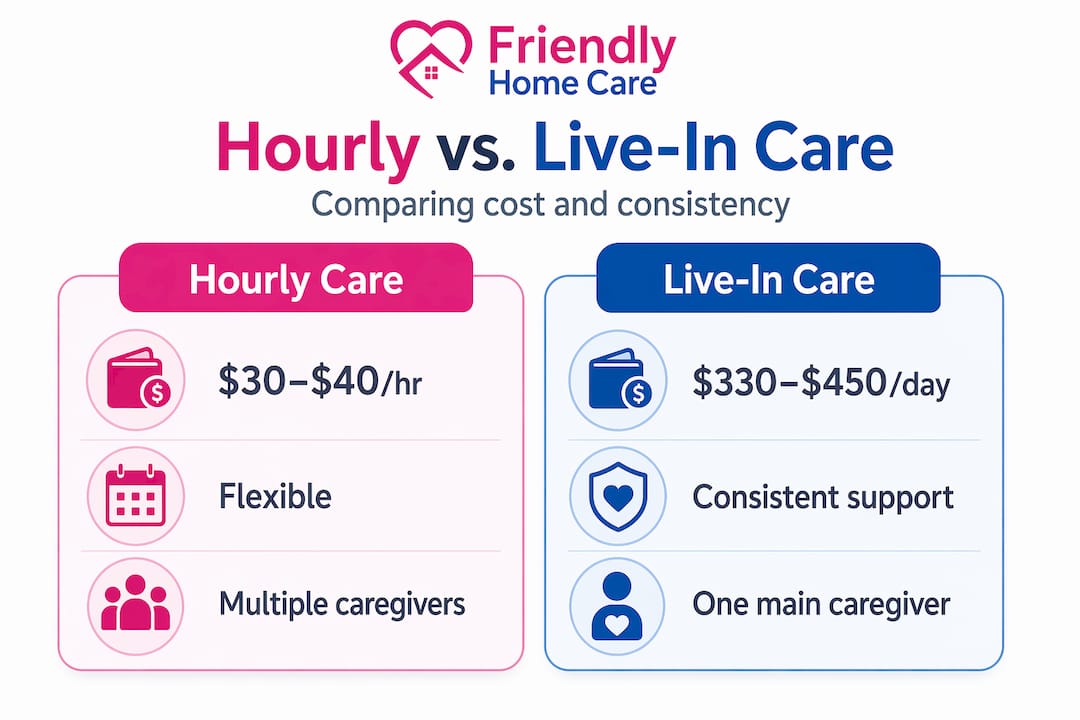
Here is a practical comparison to frame the numbers:
Care model | Estimated cost | Notes |
Hourly home care (non-medical) | $30 to $40/hr in NYC area | Pay only for hours used |
Live-in home care | $8,000 to $12,000/month | Caregiver has required rest periods |
24/7 awake care | $15,000 to $25,000+/month | Active coverage around the clock |
Assisted living facility | $4,000 to $7,000+/month | Includes housing and meals |
Hourly care is more economical for part-time support, with costs rising steeply once a family needs live-in or around-the-clock coverage. To put it in concrete terms: a senior receiving 20 hours of hourly care per week at $35 per hour spends roughly $2,800 per month. That same level of need covered by live-in care could cost three to four times more.
Several factors drive the cost of hourly home care beyond just location. The level of care required matters: home health aide services have a national median closer to $34 per hour, while homemaker or companion services run around $33 per hour. Agency rates also reflect overhead for caregiver training, insurance, and supervision. Independent caregivers hired privately may charge less upfront, but families absorb liability and management responsibilities that agencies handle on their behalf.
The bottom line: if your loved one needs fewer than eight hours of daily care, hourly home care is almost always the more affordable path.
How hourly home care works in practice
Setting up hourly home care begins with a care needs assessment. A coordinator from the agency meets with the client and family to understand health conditions, daily routines, personal preferences, and safety considerations. From that conversation, a personalized care plan is built.
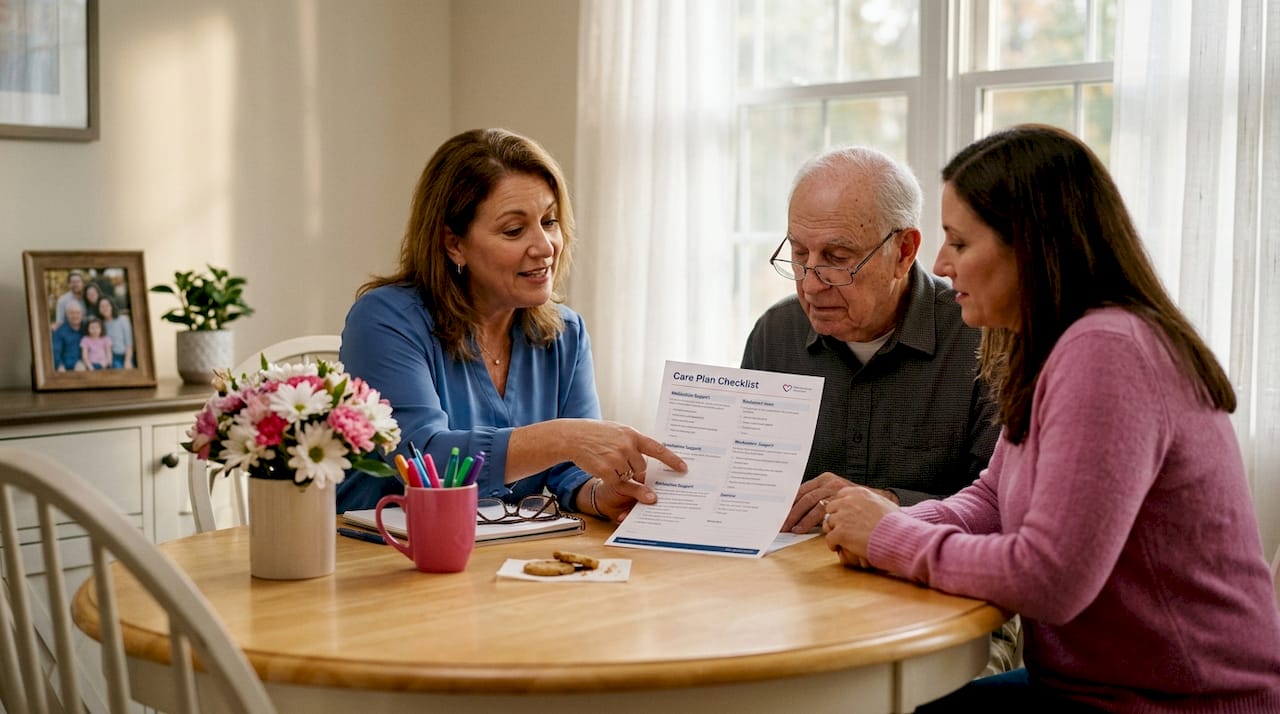
That care plan does several things at once. It defines which tasks the caregiver will perform during each visit. It sets the schedule, including days, times, and shift lengths. It also identifies any special considerations, such as mobility limitations, dietary restrictions, or language preferences. Good care plans evolve over time and should be reviewed regularly, particularly after a health event or change in condition.
Here is what families can expect once care begins:
The agency assigns a caregiver based on the care plan, availability, and fit
Shifts follow the agreed schedule, with the agency managing any coverage changes
Families receive updates and can request adjustments as needs shift
Multilingual caregivers can be matched to clients for clear communication and cultural sensitivity
Supervisory visits from agency staff help monitor care quality over time
One of the most practical tools for families managing hourly care from a distance is remote monitoring. Monitoring seniors remotely through safety technology can provide an additional layer of reassurance between caregiver visits. This works especially well for families in NYC where a senior parent may live across a borough from adult children.
Good communication between the family, the senior, and the agency is what separates a smooth care experience from a frustrating one. Be specific about your expectations upfront.
Is hourly home care the right fit?
Not every situation calls for hourly care. It is most appropriate when specific conditions are met. These indicators suggest it is likely the right model:
Your loved one is largely independent but needs support with certain activities of daily living
Care is needed during predictable windows, such as mornings, evenings, or after medical appointments
The senior is comfortable with some degree of caregiver rotation
The family wants cost-effective care without a long-term residential commitment
A short-term need exists, such as post-surgery recovery or a caregiver taking a break
The decision should always involve the senior when possible. Autonomy matters enormously to older adults, and including them in the care conversation tends to lead to better outcomes. Resistance to care often softens when the senior feels heard and respected in the decision.
Re-evaluating care regularly is not optional. It is responsible. Conditions change, sometimes slowly and sometimes suddenly. Appropriate care depends on oversight needed and social interaction, not just the current hourly rate. Families who focus only on price without considering the trajectory of their loved one’s health often find themselves scrambling to change arrangements at a stressful moment.
Pro Tip: Watch for these signs that hourly care hours may need to increase: missed medications more than once per week, unexplained falls, significant weight loss, or increasing confusion at home. These signal that current coverage may no longer be sufficient.
When it comes to choosing a provider, only work with licensed agencies in NYC that are authorized by the New York State Department of Health. Licensing and accreditation are not formalities. They protect your loved one.
My honest take on hourly care after years in this field
I’ve seen families delay hourly home care because they assume it’s either too expensive or “not quite enough.” Both assumptions cost them. The truth is that hourly home care occupies a sweet spot that a lot of care planning misses entirely.
In my experience, the families who get the most value out of hourly care are the ones who treat the care plan as a living document, not a one-time setup. They check in regularly, they advocate for their loved one’s preferences, and they’re willing to increase hours gradually rather than waiting for a crisis to force their hand.
What I’ve also found is that hourly care does something emotionally that live-in care sometimes can’t. It gives the senior space. It preserves the feeling that this is still their home and their life, with help arriving on a schedule rather than a caregiver always present. For seniors who strongly value independence, that distinction is the difference between accepting care and resisting it entirely.
The cost transparency of hourly care is something I genuinely appreciate. Families can see exactly what they’re spending, adjust based on real needs, and avoid being locked into a flat rate that doesn’t reflect how much help is actually being used. That kind of flexibility and cost transparency helps families balance caregiving with the rest of their lives without burning out financially or emotionally.
If I could offer one piece of advice: start earlier than you think you need to. A few hours per week introduced gradually is far easier on everyone than a sudden full-care arrangement triggered by a fall or hospitalization.
— Brigid
How Friendlyhomecareny can help your family
At Friendlyhomecareny, we work with families across Brooklyn, Queens, Manhattan, the Bronx, Staten Island, and Westchester County to build hourly home care plans that genuinely match each client’s needs. We are licensed by the New York State Department of Health and accredited by The Joint Commission, so you can trust that the care your loved one receives meets rigorous professional standards.
Our home health services include personal care assistance, meal preparation, companionship, mobility support, medication reminders, and post-hospital recovery support, all delivered by trained, screened, and multilingual caregivers. We customize every care plan around the individual, not a template. Whether your family needs a few hours per week to start or a more structured schedule, we are ready to help you figure out the right fit. Contact us today to schedule a consultation and take the first step toward professional, compassionate care for your loved one.
FAQ
What does hourly home care include?
Hourly home care typically includes personal care assistance, meal preparation, light housekeeping, companionship, mobility support, and medication reminders, all provided during scheduled caregiver shifts in the client’s home.
How much does hourly home care cost in New York City?
In NYC, hourly home care generally ranges from $30 to over $40 per hour depending on the level of care and agency. Families needing 20 hours per week can expect to spend approximately $2,400 to $3,200 per month.
How is hourly home care different from live-in care?
Hourly care involves a caregiver working scheduled shifts and then leaving, while live-in care means a caregiver resides in the home. Live-in care offers more continuity, but hourly care is more cost-effective for those who only need part-time support.
Can I increase hourly care hours as my loved one’s needs change?
Yes. Hourly home care schedules are flexible and adjustable. Many families start with 10 to 20 hours per week and gradually increase coverage as their loved one’s health or mobility changes over time.
How do I find a trustworthy hourly home care provider in NYC?
Look for agencies licensed by the New York State Department of Health and accredited by recognized bodies like The Joint Commission. Ask about caregiver screening, training, multilingual capabilities, and how they handle scheduling changes or emergencies.
Recommended