
Why seek reliable home care for your loved one's well-being
TL;DR:
Reliable home care requires legal licensing, verified credentials, and consistent supervision to ensure safety and accountability. It supports independence, dignity, and emotional security, reducing hospitalizations and alleviating family stress. Families should verify agency licenses, oversee care plans, and prioritize trust to provide quality, person-centered support at home.
Most families begin looking for home care when a crisis hits. A fall, a hospital discharge, a sudden change in a parent’s ability to manage daily life. In those moments, the instinct is to find someone kind, available, and affordable. But kindness alone is not enough. Most seniors want to age at home, yet confidence in actually receiving the right help remains low. Reliability in home care goes far beyond personality. It involves legal accountability, proper training, agency oversight, and consistent communication. For families across New York City and Westchester County, understanding what genuine reliability looks like can be the difference between safety and serious harm.
Table of Contents
Key Takeaways
Point | Details |
Reliability means more | It’s about legal standards, training, and trust—not just kindness. |
Safety and well-being | Reliable care reduces hospitalizations and protects physical and mental health. |
Supports independence | Consistency lets seniors remain at home with dignity and social engagement. |
Verification matters | Check credentials, agency licensing, and involve family in care planning. |
What does reliable home care really mean?
Many families assume that as long as a caregiver is kind and shows up on time, they have found reliable care. That thinking, while understandable, leaves out some of the most important parts of what reliable home care actually requires.
True reliability in home care means your loved one is protected at every level. That includes the caregiver’s professional training, verified background checks, ongoing supervision, clear documentation, and the legal standing of the agency providing the care. In New York State, home health agencies are required to hold a Licensed Home Care Services Agency (LHCSA) license issued by the New York State Department of Health. This license is not a formality. It represents a legally enforced standard that governs how care is delivered, how staff are screened, and how complaints are handled.
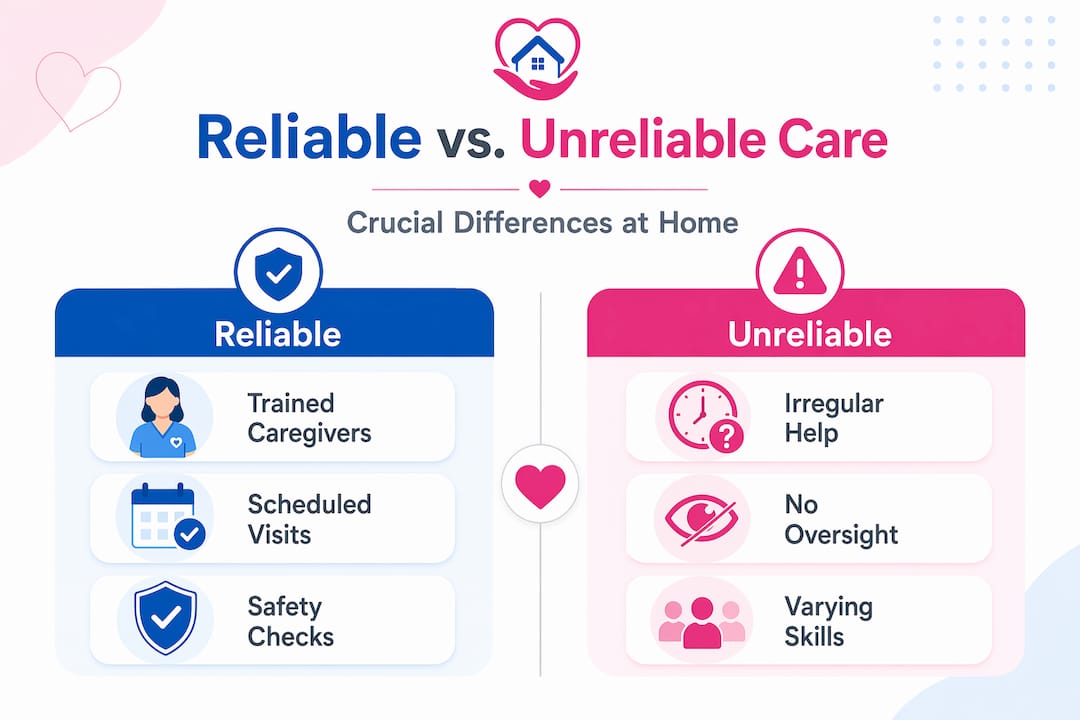
When you arrange care through an informal or unlicensed arrangement, those protections disappear. There is no regulatory body overseeing the caregiver. There is no agency responsible if something goes wrong. No required supervision. No emergency backup if the caregiver calls out sick. This is one of the most overlooked risks families face when they prioritize cost or convenience over compliance.
Here is what a reliable home care agency in New York should provide:
Verified LHCSA licensing from the New York State Department of Health
Criminal background checks completed before any caregiver enters a client’s home
Documented caregiver training, including first aid, infection control, and personal care protocols
Supervisory visits by a nurse or care coordinator to assess quality and adjust plans
Clear communication channels for families, including regular updates and care plan reviews
Emergency protocols in place so care is never interrupted unexpectedly
“Reliable home care means more than character. It means legal compliance, verified credentialing, and institutional accountability that protects your loved one even on the hardest days.”
Reading our safe home care guide can help you understand what families in NYC should look for when evaluating their options.
Why choose reliable care? Safety, well-being, and peace of mind
Defining reliability is the first step. Understanding why it matters so urgently is what moves families to act on it.
The data on this is clear. Reliable home care reduces avoidable hospitalizations, particularly during the critical weeks following a hospital discharge. When a trained caregiver monitors a senior’s condition at home, catches early warning signs, and communicates changes to the care team, many emergency situations can be prevented before they escalate. For older adults managing chronic conditions like heart disease, diabetes, or dementia, this kind of steady support is not optional. It is essential.
Situation | With reliable home care | Without reliable home care |
Post-hospital discharge | Smooth recovery, monitoring for complications | Higher risk of readmission within 30 days |
Chronic condition management | Regular oversight, medication reminders, early alerts | Missed symptoms, delayed treatment |
Family caregiver stress | Reduced burden, shared responsibility | Burnout, inconsistent coverage |
Emergency preparedness | Trained caregiver with backup protocols | No plan, no coverage, potential crisis |
Beyond physical safety, reliability has a direct emotional impact on families. When you know your mother or father is being cared for by a screened, trained, and supervised professional, you can return to your own life, your own children, and your own work without constant anxiety. That peace of mind is real and valuable. It allows adult children to be present as family members rather than constant crisis managers.
The psychological toll on family caregivers who try to manage care alone or through unreliable informal arrangements is significant. Fatigue, guilt, and worry accumulate quickly. Reliable agency-based care creates breathing room.
Pro Tip: When interviewing home care agencies, ask specifically about their emergency coverage policy. What happens if your loved one’s assigned caregiver calls out sick on short notice? Agencies that can answer this question clearly and immediately are showing you something important about their operational reliability.
Supporting independence for seniors through consistent, structured care at home is one of the most important things a family can do. Understanding the broader importance of home care helps families make well-informed decisions rather than reactive ones.
How reliable home care supports independence and dignity
Safety matters. But for most families, dignity is equally important. Your loved one is not just a list of medical needs. They are a person with preferences, routines, relationships, and a lifetime of independence they want to preserve.
Three quarters of adults 50 and older want to stay in their current homes as they age. The desire to remain in familiar surroundings, near their neighbors and their belongings, is not just sentimental. It has measurable effects on mental health, cognitive engagement, and overall quality of life. Reliable home care makes that possible in ways that ad hoc or informal arrangements cannot.
Research confirms that home-based services support psychosocial well-being while also reducing the burden on family caregivers. When care is consistent, elders develop real relationships with their caregivers. They know who is coming, when they are arriving, and what to expect. That predictability creates emotional security.
Here is how reliable agency-based care compares to informal or unregulated arrangements in terms of dignity and independence:
Factor | Reliable agency care | Informal/unregulated care |
Routine and consistency | Scheduled visits, same caregivers when possible | Variable, depends on individual availability |
Client voice in care plan | Formal care plan with client input | No structured plan |
Caregiver accountability | Supervised, documented, agency-managed | No oversight mechanism |
Emotional connection | Trained in person-centered care | Varies widely |
Backup coverage | Agency ensures continuity | Client or family must find alternative |
Reliable home care also means caregivers are trained to respect autonomy. A good caregiver does not take over. They support. They help a senior get dressed rather than dressing them without asking. They offer meal options rather than deciding unilaterally. These small moments of respect accumulate into a sense of dignity that makes a real difference in how a person feels about their daily life.
Key elements of dignity-centered, reliable care include:
Honoring daily routines like waking up at a preferred time or watching a favorite program
Encouraging participation in personal care decisions, even when physical help is needed
Providing companionship that is genuine, not transactional
Respecting cultural and language preferences, which is especially important across diverse NYC communities
Listening to feedback and adjusting care plans accordingly
Pro Tip: Ask potential agencies whether their caregivers are trained in person-centered care approaches, not just task completion. Agencies that can explain what this means in practice are taking your loved one’s dignity seriously.
Families can find helpful guidance on supporting seniors at home as part of building a care approach that preserves quality of life. For those managing cognitive conditions, dementia care and dignity are closely linked in ways that reliable care structures directly address. It also helps to explore practical resources on staying active while aging to understand the full picture of well-being for older adults at home.
Ensuring you get reliability: Credentialing, compliance, and family involvement
Knowing what reliability means is one thing. Knowing how to verify it before you trust an agency with your loved one’s care is another.
Here are the concrete steps every family in NYC and Westchester should take:
Confirm LHCSA licensing. Use the New York State Health Department directory to verify that any agency you are considering holds an active license. Do not take their word for it. Check the database directly.
Ask about background checks. Every caregiver entering your loved one’s home should have passed a criminal background check and been cleared through the New York State Central Register.
Request information about training. Ask what training caregivers complete before their first assignment. Reputable agencies provide initial orientation, skills training, and ongoing in-service education.
Ask about supervisory visits. Find out how often a nurse or care coordinator reviews your loved one’s care in person. Regular supervisory visits are a sign of genuine quality control.
Ask about caregiver consistency. Continuity of caregiver matters for dignity and relationship-building. Ask how often assignments change and what the policy is.
Clarify your role in the care plan. Families should be actively involved in creating and updating care plans, not treated as bystanders.
Your involvement does not stop at the start of care. Reliable agencies welcome ongoing family feedback. They hold regular check-ins, provide progress updates, and adjust care plans as needs change. If an agency discourages your involvement or makes it difficult to reach a supervisor, treat that as a serious warning sign.
“Families who stay actively engaged in their loved one’s care plan are better positioned to catch problems early and ensure care stays person-centered over time.”
Families navigating these choices will find our guidance on planning safe senior care helpful in organizing their evaluation process. Understanding the role of home care in senior wellness also helps families see the bigger picture beyond immediate tasks.
The overlooked value of reliability: It’s about trust, not just risk
Most guides on home care reliability focus almost entirely on risk prevention. Background checks, licensing, insurance. That checklist matters. But we believe there is a bigger truth most families miss.
Reliability is not just about protecting your loved one from harm. It is about creating the conditions for real human connection. When a senior knows their caregiver will arrive on time, every time, something shifts. They stop bracing for uncertainty. They begin to feel seen, cared about, and genuinely supported. That sense of steady, trusted presence has a value that no safety checklist fully captures.
Most older adults who want to age in place are not primarily worried about emergencies. They worry about loneliness, losing their sense of purpose, and depending on people who do not truly know them. Reliable care, delivered by familiar faces who understand a person’s preferences and history, directly addresses those fears.
We also want to challenge the idea that reliability only matters when medical needs are high. Families often wait until a loved one’s situation becomes critical before seeking agency-based care. But by that point, isolation may already be deepening, and the family caregiver may already be burning out. Starting reliable, consistent support earlier, even for lower-acuity needs like companionship, light household help, and personal care assistance, prevents a gradual decline in both the senior’s well-being and the family’s capacity to cope.
Helping families understand the value of early, steady support is part of why we emphasize transitioning to home care as a proactive step, not a last resort. Reliability builds trust over time. And trust is what allows a senior to truly thrive at home, not just survive.
Compassionate home care that puts reliability first
Everything we have covered here reflects what we work to deliver every day at Friendly Home Care. We are fully licensed by the New York State Department of Health and accredited by The Joint Commission, serving families across Brooklyn, Queens, Manhattan, the Bronx, Staten Island, and Westchester County. Our caregivers are screened, trained, supervised, and matched carefully to each client’s needs, language, and culture.
Whether your loved one needs help with daily activities, post-hospital recovery, memory care support, or steady companionship, we build care plans around the whole person, not just a list of tasks. We welcome family involvement at every stage. Explore our personalized home health services to see how we can support your family with the reliability and warmth your loved one deserves. Reaching out for a consultation costs nothing and could mean everything.
Frequently asked questions
What are the signs my loved one needs reliable home care?
Watch for changes in mobility, frequent hospital visits, difficulty managing personal care, or signs of increasing isolation. Chronic conditions often limit daily activities, and consistent home-based support can address both physical and emotional needs before a crisis develops.
What makes an agency “reliable” in New York?
Agencies must hold a current LHCSA license regulated by NYS DOH, conduct criminal background checks on all caregivers, and provide ongoing training and supervisory oversight. Reliability also includes consistent communication with families and clear emergency coverage policies.
Are reliable home care agencies covered by insurance or Medicaid?
Many licensed agencies in New York accept long-term care insurance and participate in Medicaid programs, including Managed Long-Term Care (MLTC) plans. Always confirm coverage details directly with the agency before beginning services.
How do I verify an agency’s credentials in NYC or Westchester?
You can use the New York State Health Department directory to search for active LHCSA-licensed agencies by name or location, giving you direct confirmation of their standing before you make any commitments.
Recommended