
Home Care for Disabled Adults in NYC: A Family Guide
TL;DR:
NYC offers extensive home care programs for disabled adults, including Medicaid and community services.
Qualification depends on Medicaid eligibility, functional needs, and proper assessments.
Advocacy and personal relationships with care coordinators improve care access and quality.
Navigating New York City’s home care system can feel overwhelming, especially when your loved one needs help now. Between Medicaid programs, eligibility rules, assessments, and waitlists, families often don’t know where to start. The good news is that NYC offers more options for disabled adults than almost any other city in the country. This guide walks you through every major program, how to qualify, what services to expect, and what to do when the system doesn’t cooperate. Whether you’re just starting to explore options or you’ve already hit a wall, you’ll find clear, practical answers here.
Table of Contents
Key Takeaways
Point | Details |
Multiple program options | NYC offers several Medicaid and public programs for disabled adults, each with unique eligibility and benefits. |
Financial and care assessments | Qualifying requires income/assets checks and an assessment of daily living needs or supervised care. |
Custom support services | Home care covers personal care, mobility, nutrition, and more, all tailored to individual needs by professional staff. |
Gaps and alternatives | Waitlists, program exclusions, and staffing issues mean families may need to explore private pay or additional supports. |
Advocacy is essential | Persistent advocacy and clear communication with care managers are key to securing the right support for your loved one. |
Understanding home care options for disabled adults in NYC
New York City has several distinct programs designed to help disabled adults receive care at home rather than in a facility. Each program has its own rules, benefits, and target population. Understanding which one fits your family member’s situation is the first and most important step.
NYC home care programs include Personal Care Services (PCS), the Consumer Directed Personal Assistance Program (CDPAP), the Nursing Home Transition and Diversion (NHTD) Waiver, the Traumatic Brain Injury (TBI) Waiver, and services through OPWDD (Office for People With Developmental Disabilities). Each serves a different population and offers a different level of flexibility.
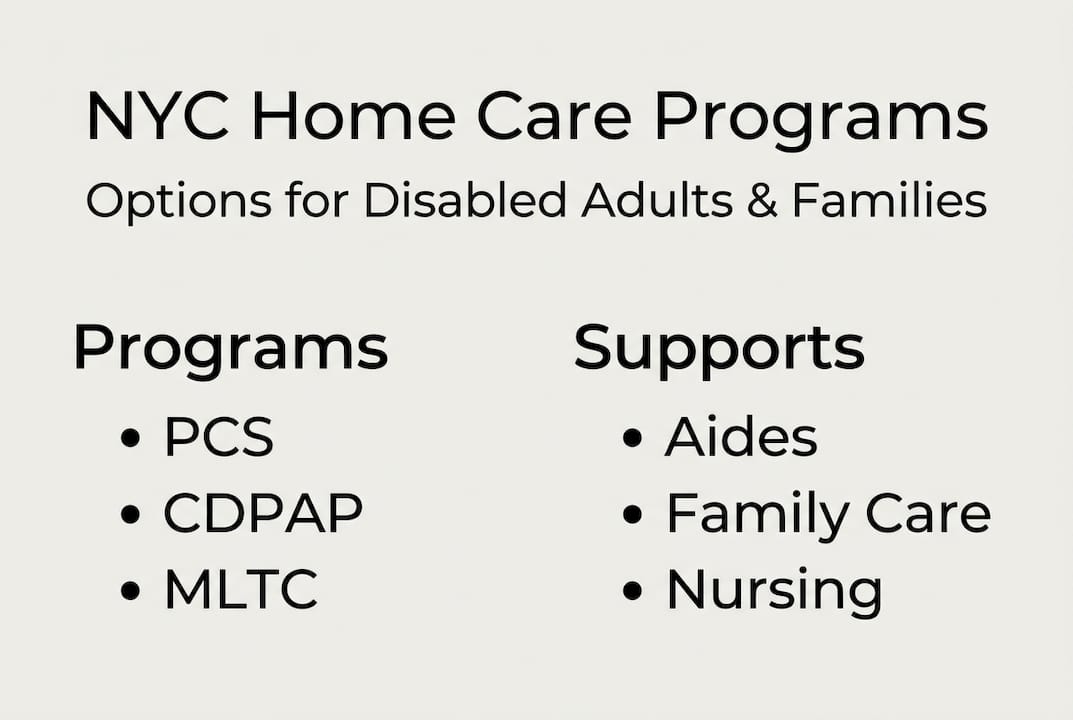
One of the most talked-about options is CDPAP. Unlike traditional home care, CDPAP lets family members or close friends serve as paid caregivers, with one exception: spouses cannot be paid caregivers, and parents cannot be paid to care for minor children. This is a powerful option for families who already provide daily support and want to be compensated for that work.
For seniors who don’t qualify for Medicaid, NYC Aging (formerly DFTA) offers non-Medicaid home care and case management services. These programs are income-based but not as strict as Medicaid, making them a useful bridge for families in the middle.
Programs like CDPAP report high satisfaction among participants, but growing demand means waitlists are increasingly common across NYC’s home care landscape.
Before choosing a program, ask yourself these key questions:
Does my loved one have a Medicaid-qualifying diagnosis or functional limitation?
Do we want a family member to serve as the paid caregiver?
Is the need short-term (post-hospital) or long-term (chronic disability)?
Does the person have a developmental disability or a brain injury requiring a specialized waiver?
Are we within income and asset limits for Medicaid?
For a deeper look at what personal care actually involves day to day, our personal care services guide breaks it down clearly. You can also explore our compassionate caregiving overview for a broader picture of how in-home support works in practice. A full summary of NYC care programs explained is also available for reference.
Program | Who it serves | Caregiver type | Key benefit |
PCS | Medicaid recipients needing ADL help | Agency-employed aide | Structured, supervised care |
CDPAP | Medicaid recipients who self-direct | Family or friend (not spouse) | Flexibility and family involvement |
NHTD Waiver | Adults at risk of nursing home placement | Agency or self-directed | Community integration focus |
TBI Waiver | Adults with traumatic brain injury | Specialized aides | Targeted rehabilitation support |
OPWDD | Adults with developmental disabilities | Trained support staff | Lifelong disability services |
For official details on CDPAP eligibility and how to apply, review the CDPAP official program details from the New York State Department of Health.
Getting qualified: Medicaid eligibility, assessments, and application steps
After identifying the right program, the next hurdle is qualifying. Here’s what you should know and prepare before starting the process.
In 2026, Medicaid eligibility for home care requires an individual income below $1,836 per month and countable assets under $33,038. Married couples have higher thresholds. Certain assets, like a primary home and one vehicle, are typically excluded from the asset count.
Beyond finances, there’s a functional threshold. To qualify for Medicaid home care, applicants must need limited assistance with at least three activities of daily living (ADLs), or two ADLs if the person has a diagnosis of dementia. ADLs include bathing, dressing, eating, toileting, and mobility.
Here is the step-by-step process most families follow:
Apply for Medicaid through NYC HRA (Human Resources Administration) online, by mail, or in person at a local office.
Get assessed by NYIA (New York Independent Assessor), which conducts an in-home functional evaluation to determine care needs.
Receive a care plan developed by a registered nurse or care manager based on the NYIA assessment results.
Choose a home care agency or personal assistant through your managed care plan or Medicaid managed long-term care (MLTC) plan.
Begin services once the plan is approved and the caregiver is matched.
For a detailed walkthrough of the full process, our guide on applying for home care covers each step with practical tips for NYC families. You can also find a helpful overview of NYC home care application steps from a caregiver-focused resource.
Eligibility factor | 2026 limit (individual) |
Monthly income | Under $1,836 |
Countable assets | Under $33,038 |
ADL assistance needed | 3+ (or 2+ with dementia) |
Pro Tip: During the NYIA assessment, describe your loved one’s needs on their worst days, not their best. Assessors evaluate functional ability, and underreporting can result in fewer approved care hours than your family actually needs.
What services and supports are included in NYC home care?
Once eligibility is secured, families want to know: what help will actually come into the home?
Home care services for disabled adults typically include personal care, mobility assistance, nutrition support, medication reminders, and companionship, with scheduling that can be adjusted to fit the individual’s routine. The care plan is not one-size-fits-all. It is built around the specific needs identified during assessment.
Standard services a home care aide can provide include:
Bathing, grooming, and dressing assistance
Meal preparation and feeding support
Medication reminders (not administration, unless a nurse is involved)
Light housekeeping and laundry
Mobility assistance and fall prevention
Accompaniment to medical appointments
Companionship and social engagement
Toileting and incontinence care
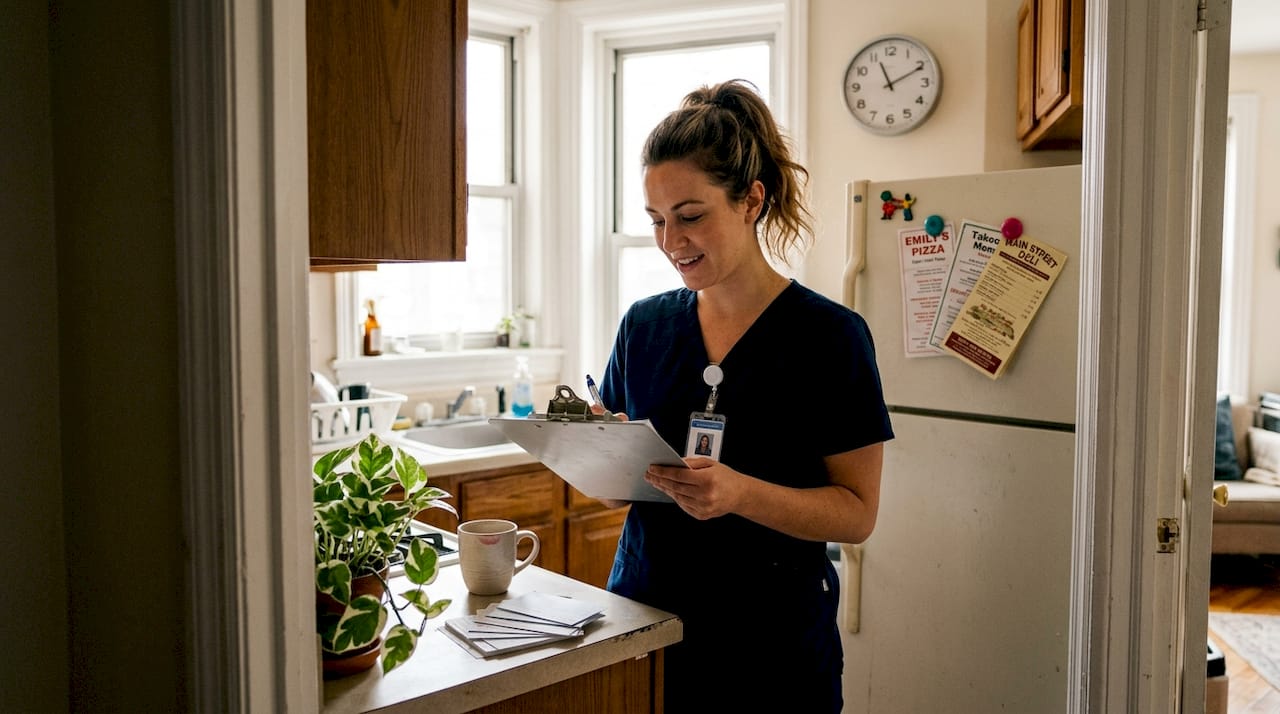
RN assessments and ongoing supervision ensure that services adapt as the person’s condition changes. A registered nurse typically reviews the care plan every 60 to 90 days, and families can request a reassessment if needs increase. This built-in quality check is one of the strongest features of agency-based home care.
For families using CDPAP, the dynamic is different. The disabled adult directs their own care, trains their caregiver, and sets the schedule. This model works well for individuals who are cognitively able to manage their own care and want maximum control. The tradeoff is that the family caregiver takes on more responsibility for training and documentation.
For more on how home care supports independence, read our article on empowering independent living. You can also explore our full range of personalized care options to see how we tailor support for each individual. Additional service details are available through Citi Health as a reference point.
Pro Tip: Don’t rely solely on Medicaid home care. Combining it with community programs, senior centers, or volunteer visitor services creates a fuller support network and reduces caregiver burnout significantly.
Alternatives, challenges, and expert solutions when home care isn’t straightforward
But what if the system doesn’t fit your loved one’s situation or immediate needs?
Not every family qualifies for Medicaid. Higher-income households, recent immigrants without sufficient residency history, and individuals who don’t meet functional thresholds may find themselves without public options. In those cases, DFTA non-Medicaid programs provide some help for seniors, but growing waitlists mean access is not guaranteed.
As of late 2025, waitlists for DFTA services exceeded 356 individuals, reflecting the pressure of NYC’s rapidly aging population. This is not a small gap. It represents real families waiting for care while managing on their own.
Groups that are commonly excluded from major programs include:
Spouses of disabled adults (cannot be paid through CDPAP)
Families above Medicaid income limits who don’t qualify for subsidized programs
Individuals who don’t meet the minimum ADL threshold
Non-citizens without qualifying immigration status
Adults with disabilities that don’t match specific waiver criteria
Combining a public program with private-pay hours is often the most practical solution for families who qualify partially or face gaps in coverage. A skilled care coordinator can map out exactly where the overlap is.
Private-pay home care is a real option for families who need immediate help or don’t qualify for public programs. Costs in NYC typically range from $25 to $35 per hour depending on the level of care and the agency. While that adds up quickly, it provides flexibility, faster start times, and often a wider choice of caregivers.
If your family is navigating these challenges, start by reading our guide on how to stay independent at home and our resource on supporting seniors at home. For families transitioning from a hospital or rehab facility, our article on transition to home healthcare is especially relevant. You can also review our planning home care steps guide for a structured approach. The aging trends in NYC report from the city also provides useful context on what families are facing.
Our take: Why personalization and advocacy matter more than ever
We’ve worked with hundreds of families across Brooklyn, Queens, the Bronx, Manhattan, and Westchester, and we’ve noticed something consistent: the families who get the best outcomes aren’t necessarily the ones with the most resources. They’re the ones who advocate loudly and consistently for their loved one.
The biggest barrier to good home care isn’t paperwork. It’s making sure your loved one’s voice, preferences, and real needs are heard and documented at every assessment. Programs are designed around averages. Your family member is not average.
“Advocacy doesn’t stop at approval; it continues as needs and conditions change.”
We’ve seen care hours get cut simply because a family didn’t flag a change in condition before the renewal period. We’ve also seen families successfully appeal denials by providing detailed documentation from their loved one’s physician. The difference was engagement, not eligibility.
Pro Tip: Build a real relationship with your loved one’s RN supervisor and care coordinator. A quick monthly check-in call does more to prevent underservice than any form you’ll ever file.
Read more about what true compassionate caregiving looks like in practice, because the emotional and relational side of care is just as important as the clinical side.
Finding trusted home care support in NYC
At Friendly Home Care, we help families across all five boroughs and Westchester navigate every step of this process, from understanding Medicaid eligibility to building a care plan that actually fits your loved one’s life. Our team includes multilingual aides and experienced care coordinators who know NYC’s home care landscape inside and out.
Explore our full range of personalized home health services to see how we match each client with the right caregiver and the right level of support. Whether you need help starting an application, choosing between programs, or filling a gap in current care, Friendly Home Care is ready to help. Reach out today to schedule a free consultation and take the first step toward reliable, compassionate care at home.
Frequently asked questions
Who qualifies for home care services for disabled adults in NYC?
Disabled adults may qualify if they meet Medicaid financial criteria and need help with daily living activities, or have a qualifying diagnosis for specialized waivers like NHTD or OPWDD.
Can family members be paid caregivers under NYC home care programs?
Yes, through CDPAP, most family members can be paid caregivers, with the exception of spouses and parents of minor children.
What services can a home care aide provide for disabled adults?
Aides help with bathing, dressing, meals, medication reminders, mobility, housekeeping, and companionship, all based on a personalized care plan developed after assessment.
What if we don’t qualify for Medicaid home care in NYC?
Families can explore DFTA non-Medicaid programs for seniors or private-pay home care, though waitlists and costs vary significantly depending on the borough and service type.
How long does it take to start services after applying?
With complete paperwork, services often begin within a few weeks of the NYIA assessment and Medicaid approval, but staffing shortages and waitlists can extend that timeline.
Recommended