
Respectful Support for Seniors: A 2026 Family Guide
TL;DR:
Respectful support for seniors involves person-centered care that maintains dignity, autonomy, safety, privacy, and respectful communication. Daily practices such as knocking, involving seniors in decisions, and avoiding Elderspeak foster respect and preserve identity. Supporting with, rather than for, seniors and planning early conversations are essential to uphold their independence and well-being.
Respectful support for seniors is defined as person-centered care that prioritizes dignity, autonomy, and individual identity over task completion. In professional care settings, this approach is also called dignity-based care or person-centered practice. Understanding what is respectful support for seniors matters because a systematic review of 27 studies found that when seniors are excluded from decisions about their own care, they experience shame and social withdrawal. That finding tells us something direct: how we help matters as much as the help itself. Respectful care sees your loved one as a whole person with a history, preferences, and the right to a voice in their daily life.
What is respectful support for seniors?
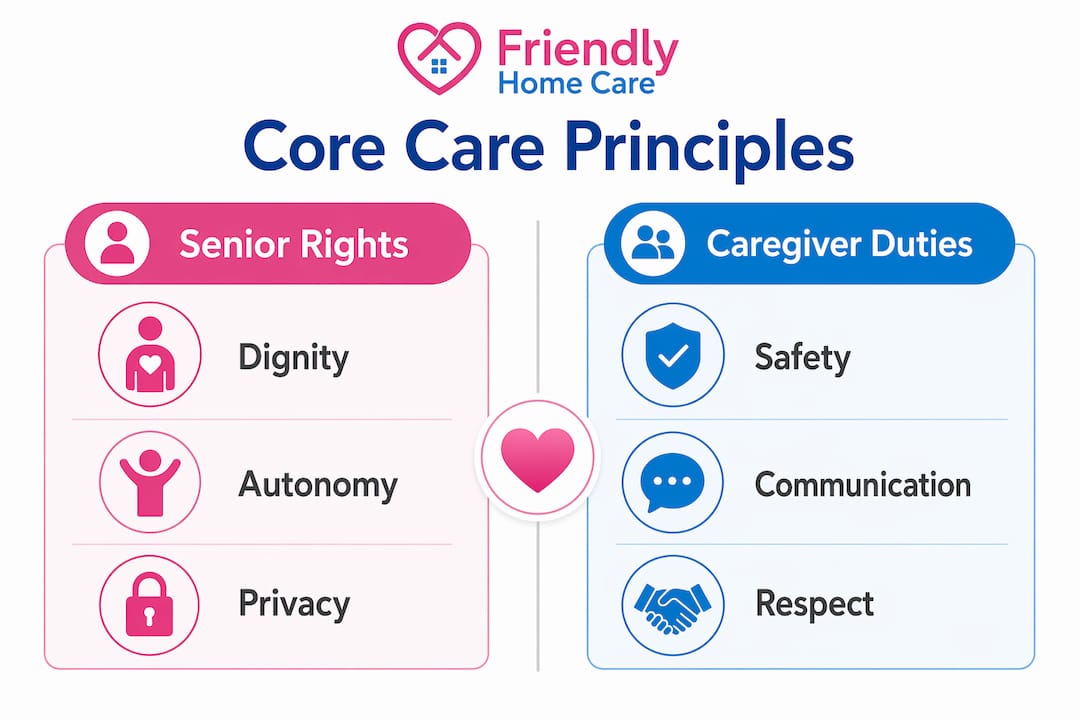
Respectful support for seniors rests on five core principles: dignity, autonomy, safety, privacy, and communication. Each principle does specific work. Together, they determine whether a senior feels cared for or merely managed.

Dignity means treating your loved one as a full adult, not a set of tasks to complete. Personalized attention that acknowledges a senior’s history, culture, and preferences affirms dignity far more than routine, task-oriented care. A caregiver who remembers that a client spent 30 years as a schoolteacher and refers to that history during conversation is practicing dignity in a concrete way.
Autonomy is about having a voice in what gets done, not doing everything yourself. Seniors who retain decision-making power over small daily choices, such as what to wear or when to eat, report stronger feelings of purpose and self-worth.
Safety must be balanced against independence. Total risk avoidance strips seniors of agency and reduces quality of life. A senior who insists on walking to the mailbox independently may face a small fall risk. Removing that choice entirely removes a source of meaning.
Privacy covers physical space and personal information. Knocking before entering a room, closing doors during personal care, and not discussing a senior’s health details in front of others all fall under this principle.
Communication shapes every interaction. Adult-to-adult eye contact, a calm tone, and using a senior’s preferred name signal respect before a single task begins.
Dignity: Acknowledge the person’s history and identity
Autonomy: Offer choices, even small ones, every day
Safety: Manage acceptable risk rather than eliminate all risk
Privacy: Knock, close doors, and protect personal information
Communication: Use preferred names, eye contact, and an adult tone
Pro Tip: Ask your loved one at the start of each week what one thing they want to decide for themselves that week. This small habit builds trust and reinforces autonomy in a practical, repeatable way.
How can families support seniors respectfully every day?
Daily respectful care for elderly relatives comes down to specific behaviors, not vague intentions. The following seven practices reflect 2026 aging-well guidance on maintaining dignity in care interactions.
Knock and ask before entering or touching. This applies even in a family home. Entering without warning removes a senior’s sense of control over their own space.
Use the senior’s preferred name. Ask directly. Do not assume a nickname is welcome. Using the wrong name, or a childish one, signals that you see the role, not the person.
Make eye contact at the same level. Sit or crouch so you are not standing over your loved one. Eye contact and adult tone communicate respect more powerfully than any specific words.
Involve seniors in every decision you can. This includes small choices like meal timing and large ones like care schedules. Involvement preserves identity and reduces resistance to support.
Support with, not for. Hand someone their toothbrush rather than brushing their teeth for them if they are capable. This distinction is the difference between assistance and control.
Avoid Elderspeak. Elderspeak is the habit of using a high-pitched voice, simplified sentences, or terms like “sweetie” or “honey” with older adults. Research shows it reduces self-esteem and can worsen behavior in care settings.
Plan care conversations in familiar, comfortable settings. Discussing care plans before a crisis, in a place where the senior feels safe, fosters genuine partnership rather than reactive decision-making.
Pro Tip: Replace “I’m going to help you get dressed now” with “Would you like to get dressed before or after breakfast?” The second phrasing hands back a small but real piece of control.
Families who want a deeper framework for these daily practices will find the compassionate care practices guide from Friendlyhomecareny a useful reference for structuring consistent, dignity-first routines.
What are the most common pitfalls in senior care?
Supporting older adults respectfully is harder than it looks. Three specific pitfalls undermine dignity even when caregivers have the best intentions.
Overprotection is the most common. Families who remove every risk from a senior’s life, including driving, cooking, or going outside alone, often believe they are being responsible. The reality is that managing acceptable risk preserves a senior’s sense of purpose and agency. Removing all risk removes all agency with it.
Infantilizing language is the second pitfall. Elderspeak, as noted above, is not just annoying. It actively harms seniors’ emotional outcomes and can increase agitation in people with dementia. The fix is straightforward: speak to your loved one the way you would speak to a respected colleague.
Ignoring the senior’s voice is the third pitfall, and the most damaging. When families make care decisions in conversations that exclude the senior, the message received is: your opinion does not count here.
“Dignity is about having a voice in what gets done, not doing everything yourself.” — Aging Untold Experts on Dignity
The solution to all three pitfalls is the same: shift from a caregiver role to a collaborative consultant role. Use language that invites seniors to co-solve problems. “What would make this easier for you?” works better than “Here’s what we’re going to do.” That shift in framing changes the entire dynamic of a care relationship.
Watch for overprotection: ask whether a restriction is for safety or for your own comfort
Replace Elderspeak with a normal adult tone in every interaction
Include the senior in every care conversation, even briefly
Use collaborative language that invites input rather than announcing decisions
How does respectful support change with cognitive decline?
Cognitive decline, including dementia, does not end a senior’s right to dignity and involvement. The approach to supporting older adults with reduced decision-making capacity requires adjustment, not abandonment of respect.
Supported decision-making is the recognized framework for this situation. Australian aged care law defines it as a legal priority: families and caregivers act to reinforce a senior’s personhood and choices wherever possible, stepping in only when genuinely necessary. The principle applies equally in New York State care settings. The goal is to enable choice, not replace it.
Experts recommend talking to seniors, not about them, regardless of dementia status. Even when a senior cannot fully follow a conversation, being addressed directly communicates respect. Being talked about in the third person while present communicates the opposite.
Life stories and advance care plans are practical tools here. A written record of a senior’s preferences, values, and personal history helps caregivers personalize interactions even when verbal communication becomes limited. Friendlyhomecareny’s approach to dementia care at home reflects this principle directly, keeping the senior’s voice central even as their needs change.
Situation | Standard Approach | Dignity-First Approach |
Choosing daily activities | Caregiver selects based on schedule | Senior chooses from two or three options |
Personal care tasks | Caregiver completes tasks efficiently | Caregiver explains each step and asks permission |
Care planning meetings | Family and staff discuss without senior | Senior is present and addressed directly |
Cognitive decline decisions | Family decides what is best | Supported decision-making framework guides choices |
Communication during care | Caregiver talks to other staff | Caregiver speaks directly to the senior throughout |
Planning ahead matters more than most families realize. Having care preference conversations early, in a familiar setting and before a health crisis forces the issue, gives seniors the best chance to shape their own care. That conversation is one of the most respectful things a family can do.
Key takeaways
Respectful support for seniors requires consistent, specific behaviors that honor dignity and autonomy, not just good intentions.
Point | Details |
Dignity-first care is defined | Person-centered practice that honors identity, autonomy, and voice in every interaction. |
Five core principles guide care | Dignity, autonomy, safety, privacy, and communication work together to preserve quality of life. |
Daily behaviors make the difference | Knocking, using preferred names, and offering choices are concrete ways to show respect every day. |
Overprotection harms seniors | Removing all risk strips away purpose and agency; manage acceptable risk instead. |
Cognitive decline requires adaptation | Supported decision-making frameworks keep seniors’ voices central even when capacity is reduced. |
What i’ve learned about respectful senior care
By Brigid
After years of working alongside families navigating senior care, the pattern I see most often surprises people. The families who struggle most are not the ones who care least. They are the ones who care so much that they start doing everything for their loved one without realizing what they are taking away.
The hardest shift is from helper to partner. Most of us were raised to fix problems. When a parent or grandparent needs help, the instinct is to step in and handle it. But handling it for someone is not the same as handling it with them. That distinction changes everything about how a senior feels in their own home.
Active listening is underrated in care conversations. Sitting quietly while a senior tells you what they want, even if it takes longer than you expected, is one of the most respectful things you can do. You learn things you would never have thought to ask. Those details become the foundation of care that actually fits the person.
The advice I give families most often is this: have the hard conversations early. Talk about preferences, routines, and values before a health event forces the issue. Seniors who have been heard in advance feel far more in control when support becomes necessary. That sense of control is not a luxury. It is a core part of their well-being.
— Brigid
How Friendlyhomecareny supports respectful, personalized senior care
Friendlyhomecareny is a licensed, Joint Commission-accredited home healthcare agency serving Brooklyn, Queens, Manhattan, the Bronx, Staten Island, and Westchester County. Every care plan we build starts with the senior’s own preferences, history, and goals, not a standard checklist. Our trained, multilingual home health aides provide personal care assistance, companionship, mobility support, medication reminders, and help with daily living activities, all delivered with the dignity-first approach this article describes.
If you are ready to explore personalized home health services for your loved one, we are here to help you build a plan that fits. Families across New York trust us to provide care that respects who their loved one is, not just what they need. Contact Friendlyhomecareny today to schedule a consultation and take the first step toward care that truly honors your family member.
For families who want to understand how we tailor support to individual needs, our customized care plans page walks through the full process.
FAQ
What does respectful support for seniors mean?
Respectful support for seniors is person-centered care that prioritizes dignity, autonomy, and individual identity. It means involving seniors in decisions, using their preferred names, and treating them as whole adults rather than care tasks.
How do i support a senior without taking away their independence?
Use the “supporting with, not for” approach: offer help with tasks the senior finds difficult while letting them lead on tasks they can still manage. Balancing risk and autonomy preserves both safety and a sense of purpose.
What is elderspeak and why does it matter?
Elderspeak is the use of simplified language, high-pitched tones, or terms like “sweetie” when speaking to older adults. Research shows it reduces self-esteem and can worsen behavior, particularly in seniors with dementia.
How do i respect a senior with dementia during care?
Talk directly to the senior, not about them, in every interaction. Use a supported decision-making framework to offer choices wherever possible and document their preferences and life history to guide personalized care.
When should families start planning senior care?
Start care conversations before a health crisis makes them urgent. Early future-planning conversations in familiar, comfortable settings give seniors the best opportunity to shape their own care and feel in control of their future.
Recommended